
What Umbraco end of life means for your site and your roadmap

TL;DR | If you’re dealing with Umbraco End of Life, you’re carrying risk you don’t need and missing out on AI features that could genuinely help your team. Upgrading fixes both.
What does Umbraco end of life mean?
When an Umbraco version reaches end of life, it moves out of active support, meaning no more security patches, bug fixes, or official support. The site stays online, but the foundation underneath it stops being maintained.
Over time, that creates real risk. Vulnerabilities go unpatched because no further security patches are released. Integrations start requiring workarounds. Routine changes become disproportionately expensive.
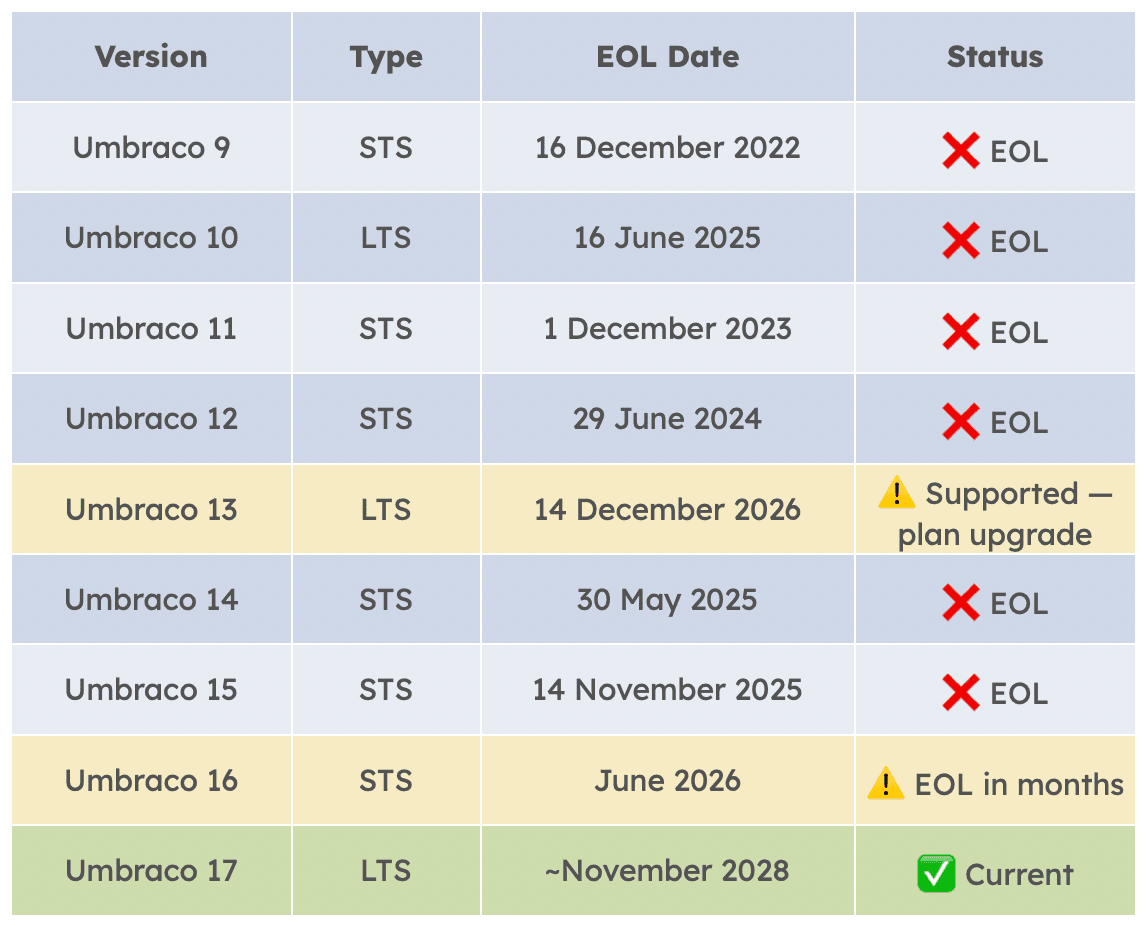
If you're not on Umbraco 17, your version is either already end of life or heading there soon. Check where you stand.
If you're on 13, you have until December 2026 - but that window fills up faster than you'd expect once planning, scoping, and delivery time are factored in. If you're on anything else below 17, the time to act is now.
Why does it feel like you just did this?
Umbraco releases two major releases per year, so version numbers climb fast.
If you upgraded to Umbraco 13 a couple of years ago and it already feels like time to move again, you're not imagining it, and you're not alone.
Umbraco HQ knows this creates fatigue. The 13 to 17 upgrade is their answer to it.
Is the 13 to 17 upgrade really that disruptive?
It can be, if it's not managed properly.
The architectural changes between 13 and 17 are significant, and without experienced guidance, teams often underestimate the complexity involved. Custom backoffice extensions, third-party packages, and content models all need careful assessment before a single line of code changes.
Done well, the upgrade is a controlled, low-risk process. Done poorly, it becomes an expensive scramble.
That’s where experience matters. Koben’s team has navigated these upgrades across a range of site types and complexities. We know where the risk lives, and how to manage it before it becomes a problem.
Once you're on 17, the outlook improves significantly. You're moving onto a long-term supported version, with the next LTS not due until late 2027 and support running through to at least 2030, so future upgrades are designed to be far less disruptive from here.
What if you can't upgrade before your EOL deadline?
Umbraco offers Extended Long-Term Support (XLTS) as a paid option, effectively extending support beyond standard support phases.
It buys time by continuing security patch coverage beyond EOL. It’s a useful bridge if you genuinely need it, but it’s not a substitute for upgrading. The longer you extend, the more you're paying to delay the inevitable.
Why upgrading sooner is cheaper than upgrading later
Unsupported platforms accumulate technical debt.
Workarounds get layered in. Developers spend time navigating constraints rather than delivering value. What should be a straightforward enhancement becomes a major project.
This is the hidden cost of ignoring Umbraco end of life: what looks stable on the surface is quietly becoming harder and more expensive to maintain.
If a security incident forces the issue, you're doing it urgently, without time to plan, and paying a premium for it. Proactive upgrades are almost always more controlled and more affordable than reactive ones.
What do you gain from upgrading to Umbraco 17?
- Long-term security coverage under the Extended LTS programme (five years)
- A modern, faster backoffice with improved editorial workflows
- Improved performance and scalability
- Reduced technical debt and future upgrade risk
- Access to Umbraco's new AI capabilities - none of which are available on older versions
What AI features does the new Umbraco include?
This is where it gets interesting.
The new generation of Umbraco treats AI as something you control, not something bolted on and billed at a premium.
Umbraco.AI gives you governance over which AI models are used, how they behave, and what tone of voice they follow before AI ever reaches your editors or content. You choose your provider. You pay them directly. No vendor lock-in, no hidden markups.
On top of that foundation, the Umbraco Copilot gives editors a context-aware assistant inside the backoffice, helping with content suggestions, structural improvements, and consistency checks, while keeping humans in the loop.
Through the Hosted Editor MCP, editors can describe tasks in plain language - draft a landing page, rewrite content to match brand tone, generate meta descriptions - and have them completed directly in the backoffice. No developer required.
None of this is accessible on unsupported versions.
A planned upgrade gives you control over scope, timing, and budget. Done well, it’s also a checkpoint - an opportunity to review performance, close SEO gaps, tighten accessibility, and clean up integrations.
The disruption risk is far higher when something forces your hand.
What should you do next?
Find out which version you're running.
If your current Umbraco version is out of support, now is the time to plan your next move. If you're on Umbraco 13, start planning your path to 17. You have until December 2026, but that window fills up faster than you'd expect. If you're on anything older, the time to act is now.
Your CMS should be supporting your growth, not quietly working against it.
Talk to us about an Umbraco upgrade.
FAQ
What is the current Umbraco LTS version?
Umbraco 17, released November 2025. Five-year Extended LTS coverage through to approximately November 2028.
When does Umbraco 13 reach end of life?
14 December 2026. If you're on Umbraco 13, start planning your upgrade to Umbraco 17 now - leaving it late adds cost and risk.
Can I choose which AI model Umbraco uses?
Yes. Umbraco.AI lets you select your own AI provider and models, switch between them over time, and define governance rules before AI is surfaced to editors.
Do I need AI to upgrade to Umbraco 17?
No. AI features in Umbraco are entirely opt-in. You can upgrade for the security and performance benefits alone and adopt AI at whatever pace suits your organisation.
Sign up for our newsletter for more insights like this
We promise not to spam your inbox. We send a newsletter once a month or when we have something important to say that just can't wait.